
Every square meter had to sell. The brief for this commercial bakery in Qurum was uncompromising: maximum product display, seamless customer flow, and a hard line between the polished retail floor and the production kitchen behind it. What emerged is a space where raw concrete overhead and pale wood at counter level create the exact tension modern bakery retail demands.
A Commercial Bakery Built on Commercial Logic
Wasim Decor designed this bakery interior in Qurum, Muscat, as a commercial instrument — not a decorative exercise. The core challenge was direct: create a retail bakery environment that maximizes product visibility across every available display surface while maintaining spatial order, readable navigation, and a customer path free of dead zones. Ideal for bakery owners in Muscat seeking a fit-out that prioritizes selling performance over superficial aesthetics, this project treats every design decision as a business decision.
Qurum’s retail landscape is competitive. Foot traffic runs strong through the neighborhood, but attention spans are short, and first impressions determine whether a customer steps in or walks past. The client needed a space that communicates quality within seconds of entry, guides visitors past every product category without feeling forced, and separates front-of-house operations from back-of-house production with absolute clarity. The design had to project a brand identity resistant to trend fatigue — something that reads as relevant in five years as confidently as it does on opening day.
This is a bakery where the floor plan was drawn as a circulation diagram before a single fixture was specified, and where the complete equipment list was finalized before the first interior design drawing was produced.
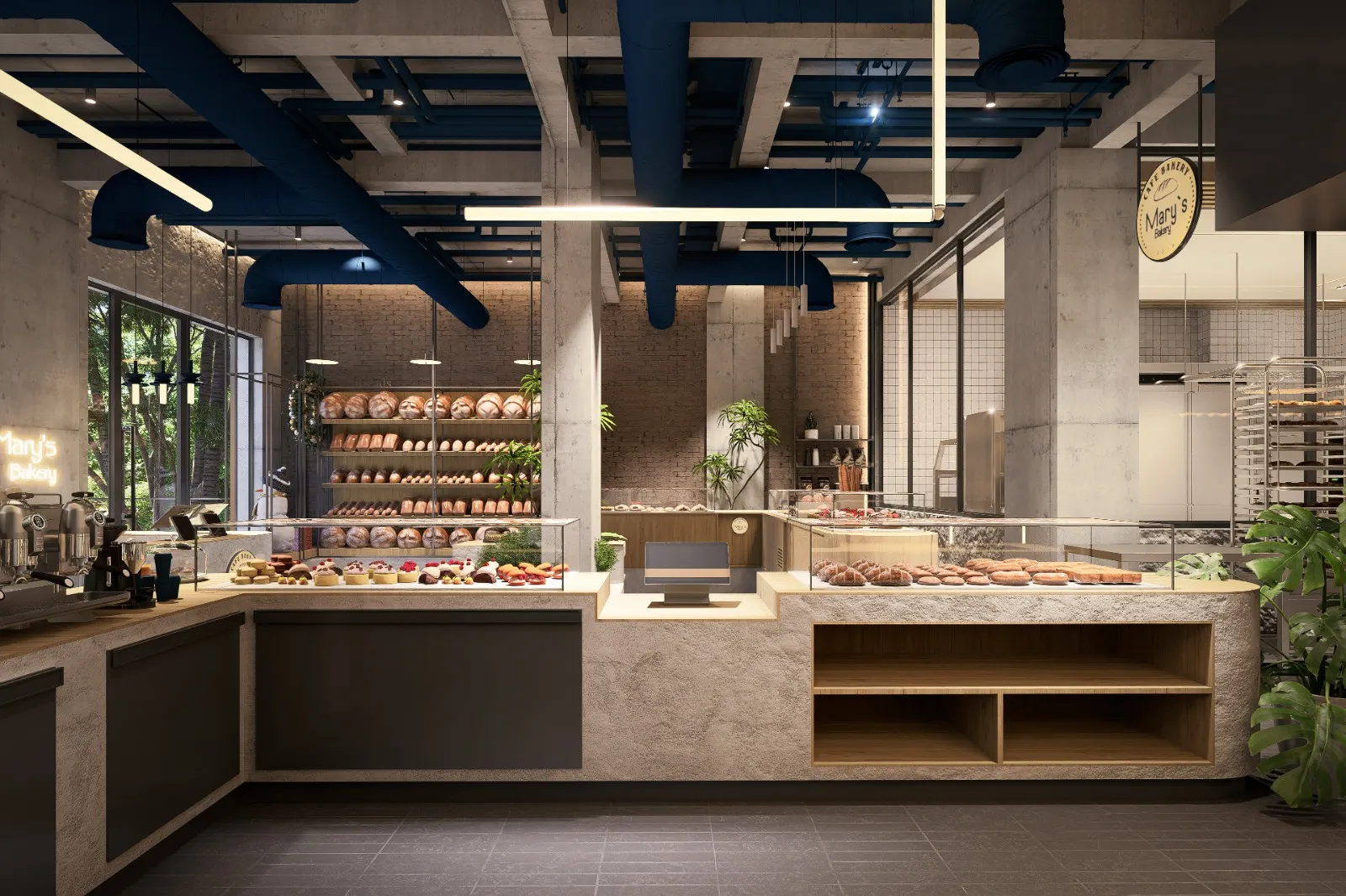
Material Palette: Concrete, Stone, and Light Wood
The color palette is built entirely on neutral and warm tones — a deliberate strategy to prevent the visual fatigue that saturated or trend-driven palettes impose within two or three seasons. This bakery was designed to age gracefully, not chase a moment.
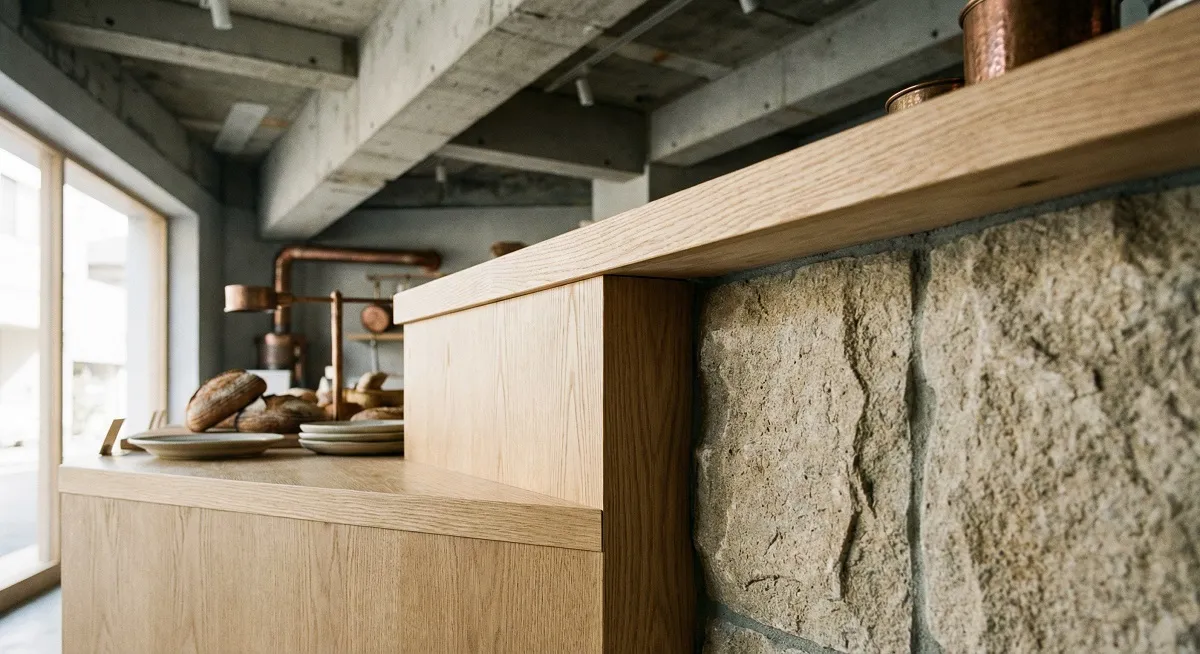
Exposed concrete defines the ceiling plane and selective wall surfaces, introducing an honest industrial texture that anchors the space without overwhelming it. Textured stone appears on feature surfaces, adding tactile depth and a sense of permanence that smooth, painted finishes simply cannot achieve. Pale wood — at the counter, along display casework, across customer-facing surfaces — introduces warmth precisely where human contact is closest. A customer leaning toward a vitrine, resting a hand on the ordering counter, or scanning the display at arm’s length encounters wood first. The material gradient is intentional: harder, cooler materials recede upward and outward, while warmer, tactile wood advances at the points of product interaction.
The three-material composition creates a coherent visual identity. Concrete reads as structure. Stone reads as character. Wood reads as hospitality. Together, they establish a bakery environment that feels contemporary and grounded — industrial enough to signal craft seriousness, warm enough to invite a second visit. No single material dominates. The balance holds.
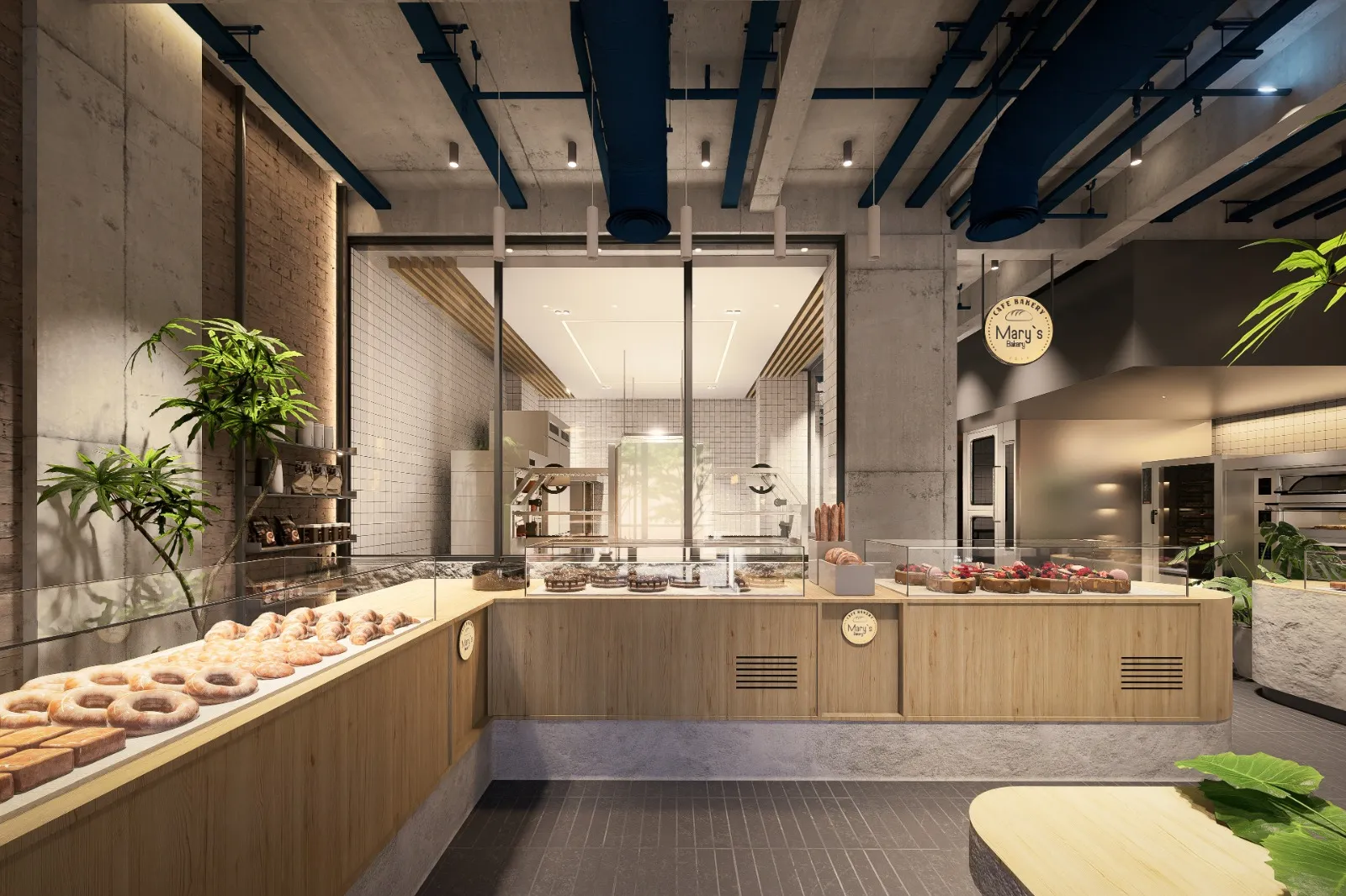
Exposed Ceiling: Industrial Identity, Practical Economy
Above the retail floor, there is no false ceiling. Ductwork, electrical conduit, and mechanical services remain fully visible — painted in coordinated tones that integrate them into the overhead plane without concealing their presence.
Height Preservation and Spatial Openness
Preserving the full ceiling height was essential. In a retail bakery where vertical display units, signage, and layered lighting all compete for overhead space, a dropped ceiling would have compressed the room and diminished the sense of openness that makes customers feel comfortable rather than confined. The exposed structure lets the space breathe, giving the eye room to travel upward before settling back down on the product displays below.
Visual Control Through Painted Services
Leaving services exposed does not mean leaving them visually chaotic. Every duct and conduit above this Qurum bakery is color-matched to a unified tone, creating visual order across the ceiling without the cost or spatial sacrifice of full concealment. The mechanical systems become part of the design vocabulary — honest, controlled, deliberate. They contribute to the industrial-modern character the space pursues rather than contradicting it.
Cost Reallocation Where It Matters
Eliminating a full false ceiling redirected budget toward the materials and fixtures customers actually see, touch, and interact with daily. Counter surfaces, display lighting, stone cladding — these received the investment that gypsum panels would have absorbed. The trade-off is visible in every detail at hand level, where the quality of material finish speaks for the priorities of the project.
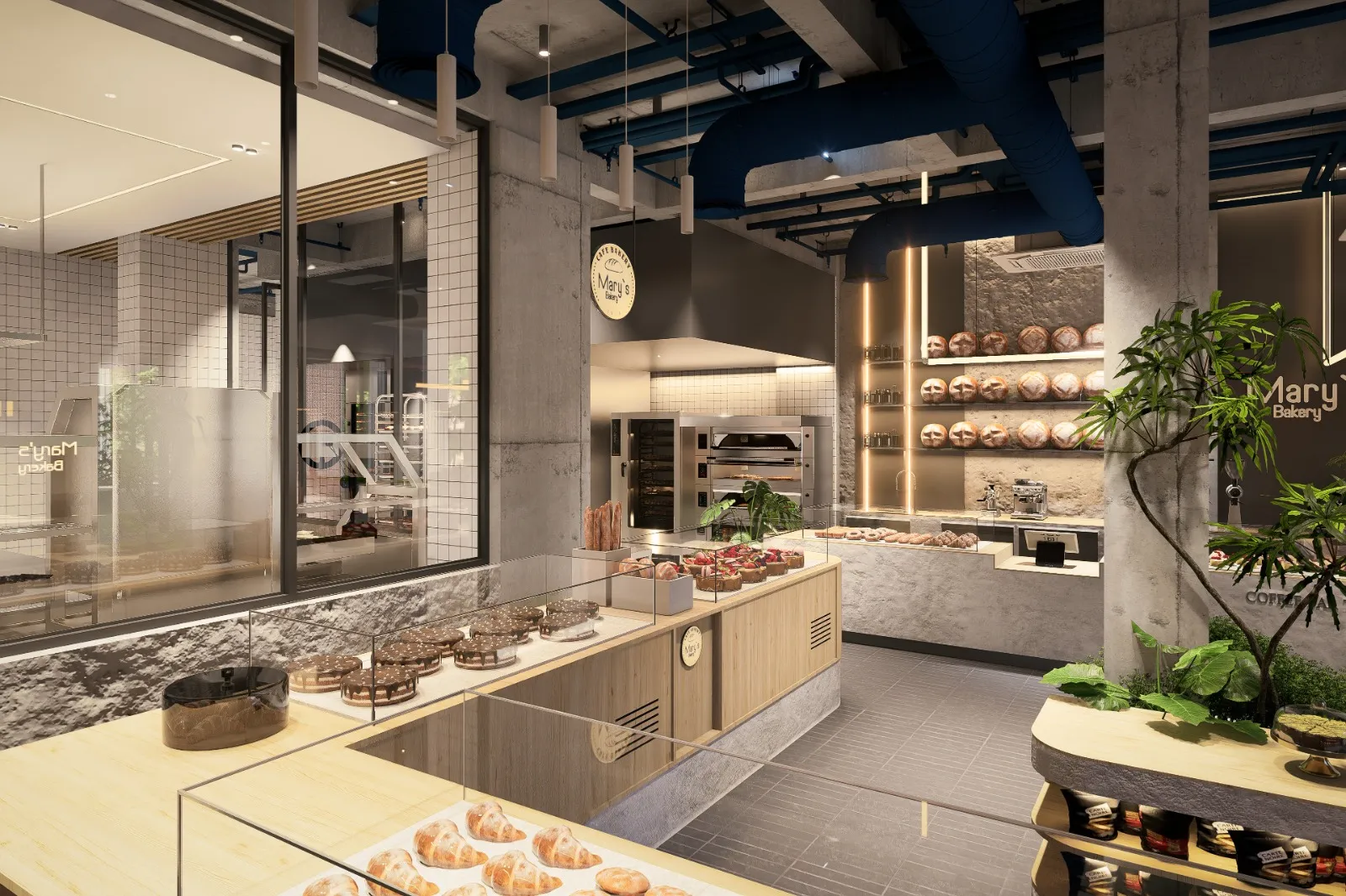
Spatial Planning: Counter, Vitrines, and Customer Circulation
Central Counter as Focal Anchor
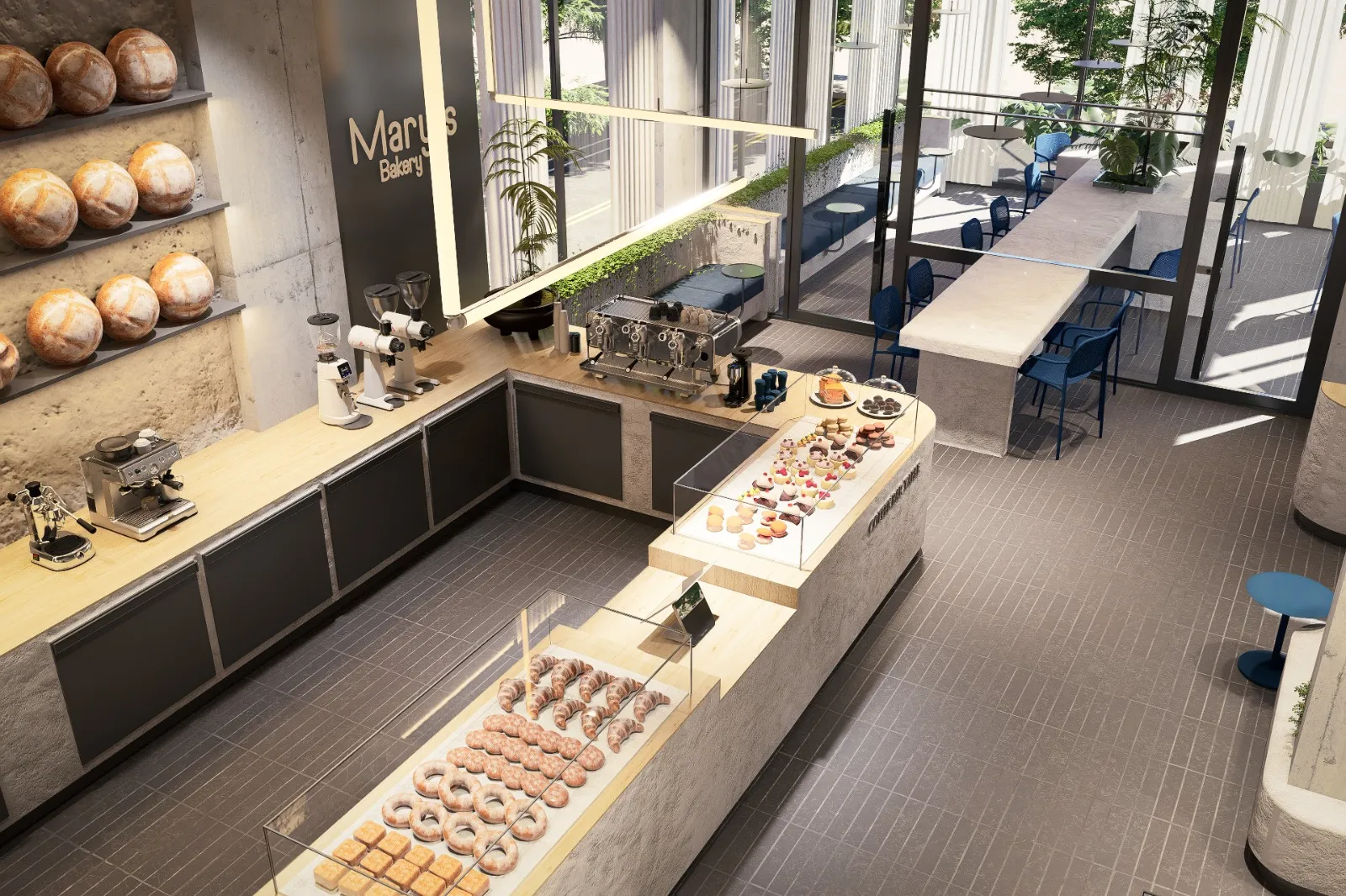
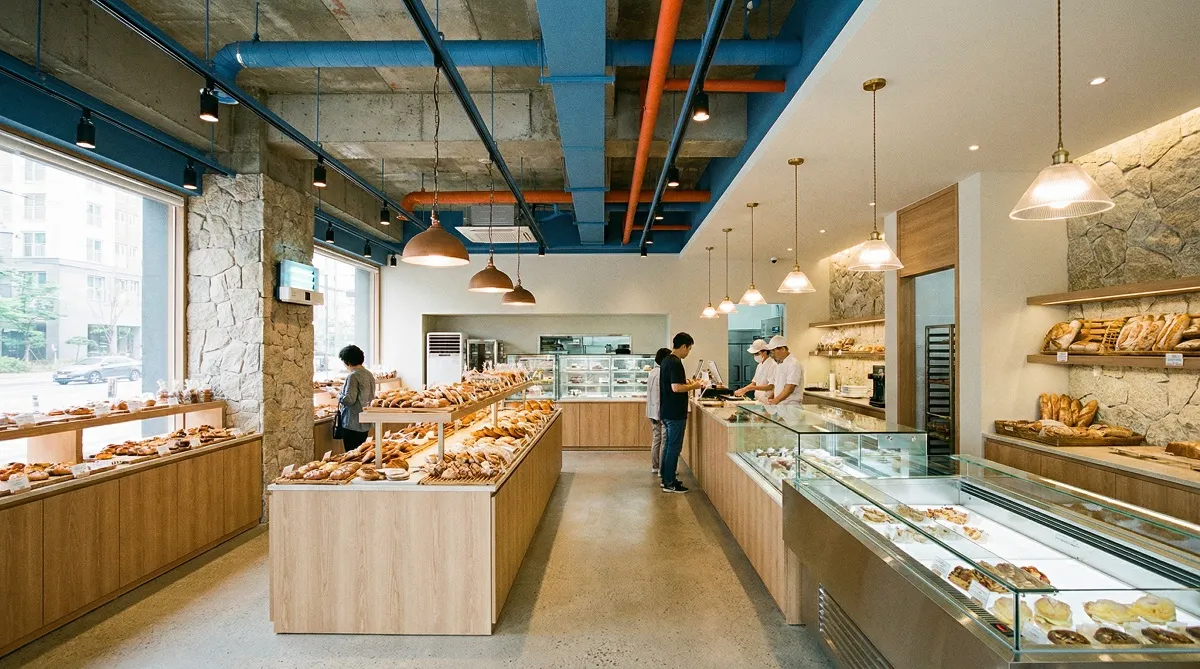
The floor plan is organized around a central counter that serves as the visual and functional anchor of the entire space. From the moment a customer crosses the threshold, the eye is drawn to this element. It establishes orientation — where to go, where to look, where to order. There is no ambiguity in the spatial hierarchy, no moment of hesitation or directional confusion. The counter announces itself.
Linear Vitrines for Maximum Product Exposure
Flanking the primary circulation path, linear display vitrines are positioned for full-frontage visibility. These are the bakery’s primary selling instruments. Their placement ensures that a customer walking from entrance to counter passes every major product category along a single, uninterrupted route. Nothing is hidden around a secondary corner. Nothing is relegated to a low-traffic zone where it goes unseen.
Standard spacing is maintained throughout the circulation path — generous enough for comfortable movement during peak hours, proportioned so products remain within arm’s reach. The balance between openness and proximity is deliberate: customers should feel they are walking through the product selection, not past it.
Three-Zone Separation: Order, Produce, Serve
The spatial plan enforces clear functional separation. The ordering zone — where product selection, communication, and payment occur — is physically and visually distinct from the production area behind it. The serving counter operates as a rapid handoff point, designed for speed and minimal confusion. Each zone occupies its own defined territory within the floor plan, preventing the operational overlap that slows service and clutters the customer experience in poorly planned retail bakery spaces.
Kitchen Separation: Clean, Dirty, and Storage as Independent Zones
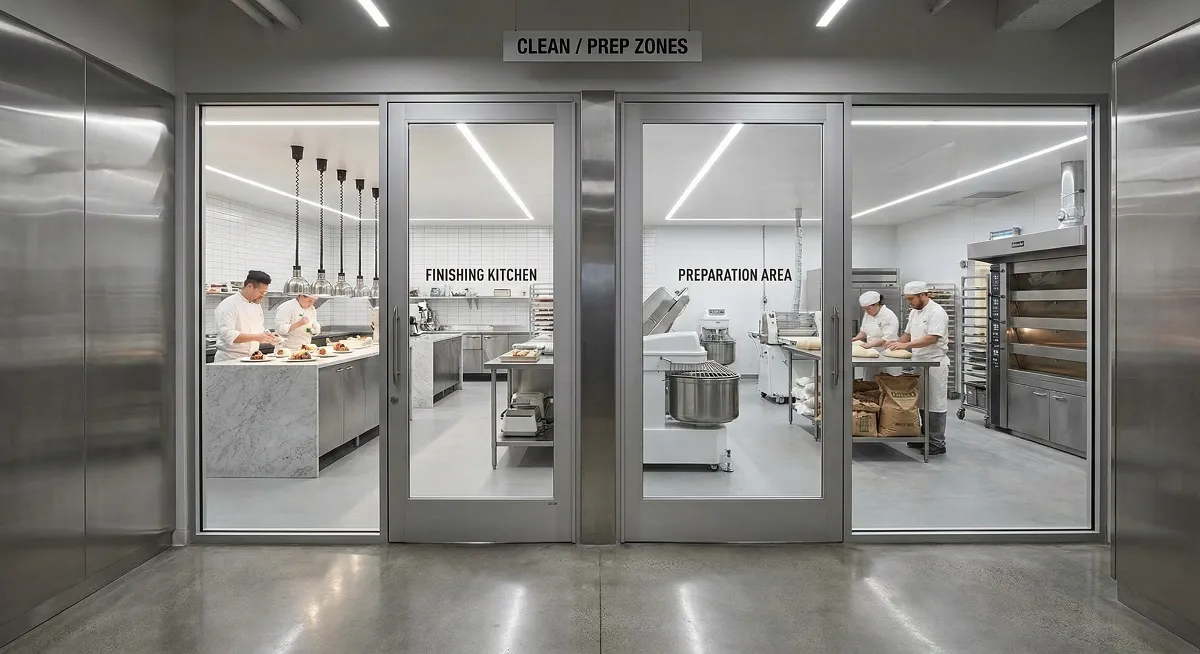
Behind the retail floor, the production environment is divided into three fully independent zones: a clean kitchen for finishing and final preparation, a dirty kitchen for raw processing and heavy dough work, and a dedicated raw materials storage area. Each zone operates with its own access, workflow logic, and hygiene perimeter.
Cross-contamination between raw ingredient handling and finished product preparation is the operational risk this layout eliminates entirely. The path from raw material delivery to finished display follows a single linear direction — ingredients enter from one access point, finished products exit from another. At no stage does this production flow intersect with the customer circulation path on the retail floor. Two parallel systems operate simultaneously: one for making bread, one for selling it.
Staff in the dirty kitchen work with flour, raw dough, and bulk ingredients without entering the clean finishing space. The clean kitchen handles glazing, decorating, plating, and display preparation in a controlled, hygienic environment. Storage feeds the dirty kitchen directly through an adjacent access point, eliminating the need to transport raw materials through active production zones.
For a commercial bakery operating at volume in Muscat, this three-zone separation pays dividends daily — in production speed, in hygiene compliance, and in the quality consistency that distinguishes a professional operation from an improvised one.
Equipment-First MEP Coordination
The Sequence That Prevents Expensive Mistakes
This is where most commercial bakery fit-outs in Muscat encounter their costliest problems — and where this project set its foundation correctly. Before a single interior design drawing was produced, Wasim Decor completed a full equipment layout for every piece of bakery machinery. Ovens, proofers, dough mixers, refrigeration units, display coolers — each was positioned on plan, and its mechanical, electrical, and plumbing requirements were documented in detail.
Only after this equipment plan was locked did the MEP engineering begin. Electrical load calculations were derived from actual equipment specifications, not rough estimates or generic allowances. Industrial ventilation and exhaust systems were sized to the real heat output and airflow demands of each production zone individually. This equipment-first sequence eliminates the costly mid-construction revisions that plague bakery projects where designers produce beautiful interiors and then discover the electrical infrastructure cannot support the selected equipment.
Floor Engineering and Long-Term Service Access
Floor detailing received the same level of rigor. Slopes were engineered for proper drainage toward standard floor drains positioned at every wet zone within the production area. Heavy equipment was placed with long-term serviceability treated as a primary constraint rather than an afterthought — access panels face corridors, not walls. Technicians can reach critical components, perform routine maintenance, and replace parts without dismantling surrounding casework or cabinetry.
The entire MEP system was designed in compliance with Muscat municipality requirements and bakery operational standards. Ventilation rates, electrical circuit separation, drainage capacity — each parameter was calculated against the actual operational demands of this specific commercial bakery, not against generic fit-out benchmarks borrowed from unrelated project types.
Lighting Strategy: Two Layers, One Commercial Purpose
Two distinct lighting systems operate across the bakery’s retail floor, each serving a different function within the same overarching commercial goal: making the product look irresistible and the space feel inviting.
Ambient Layer for Comfort and Navigation
General lighting provides even, functional illumination throughout the retail space. This base layer ensures comfortable visibility for navigation, signage reading, and spatial awareness without the harsh flatness of purely utilitarian commercial fixtures. It works quietly in the background, establishing a baseline sense of openness and cleanliness that customers register subconsciously.
Accent Layer for Product Emphasis
The second layer is where the lighting design earns its return. Focused accent fixtures target product displays with directional precision, creating the contrast and visual emphasis that draws a customer’s eye to a specific golden croissant, a particular sourdough loaf, or a seasonal pastry arrangement. Under flat, even light, baked goods look ordinary and forgettable. Under directional warm accent light — with gentle shadow defining crust texture, lamination layers, and caramelized surfaces — the same products look worth the trip and worth the price.
Color temperature was selected with bakery-specific intent. The chosen warmth renders golden bread crusts, caramel pastry tones, and natural ingredient colors exactly as the eye expects to see them — warm, appetizing, honest. A cooler temperature would push those tones toward gray and clinical. Excessive warmth would make everything appear artificially orange. The calibrated middle ground ensures that what a customer sees under the vitrine lights matches what they hold in their hand at the table — no visual deception, just accurate, flattering illumination.
What the Finished Space Delivers
The completed bakery in Qurum operates as a precision commercial environment where nothing is ornamental and everything performs. The central counter commands immediate attention and streamlines ordering. Linear vitrines expose every product category along a natural, unforced walking path. The kitchen separation ensures food safety and production speed without a single workflow collision. The lighting sells bread the way bread deserves to be sold — golden, warm, and real.
The neutral material palette — exposed concrete, textured stone, and light wood — gives the space a brand identity that will not require a refresh in two years. It reads as contemporary without chasing trends, industrial without feeling sterile. For a bakery competing in Qurum’s active retail environment, that kind of visual longevity is itself a measurable commercial advantage.
Wasim Decor’s equipment-first approach to this commercial bakery fit-out in Muscat eliminated the reactive engineering and budget overruns that typically accompany projects where design precedes operational planning. The space was designed from the equipment outward, not from the walls inward — ensuring that every electrical circuit, exhaust run, and drain position was accurate from the start.
This is bakery interior design in Muscat built on operational logic. A space engineered to sell bread, move customers efficiently, and sustain daily production — not to photograph beautifully and then fight its own layout through the first month of service.
If you are planning a bakery or commercial food retail space in Muscat, Wasim Decor brings the equipment-first methodology, material expertise, and operational design thinking that this project type demands. Reach out to discuss your brief, timeline, and spatial requirements. Visit our Google Business Profile for additional project photographs, client reviews, and examples of commercial fit-out work across Muscat.
Bakery interior design costs in Muscat depend on space size, equipment scope, material selections, and MEP complexity. Wasim Decor provides detailed project quotations after an initial consultation and equipment assessment, ensuring pricing is aligned with actual project requirements rather than rough estimates.
Bakery equipment carries specific electrical loads, ventilation demands, and drainage requirements that directly shape MEP infrastructure. Finalizing the equipment layout first allows all mechanical and electrical systems to be designed from real specifications, preventing costly mid-construction revisions that frequently disrupt bakery fit-out projects in Muscat.
Clean and dirty kitchen separation means maintaining distinct, independently accessed zones for raw material processing and finished product preparation. This prevents cross-contamination, supports food safety compliance, and increases daily production throughput — a fundamental requirement in professional bakery interior design in Muscat.
A dual-layer approach combining even ambient lighting with focused accent lighting is most effective for bakery retail. Warm color temperatures ensure bread and pastry products appear natural and appetizing, while directional accent fixtures create the visual contrast that draws customer attention to specific display areas.
Timelines vary based on project scope, equipment procurement lead times, and municipal permit processes. Wasim Decor manages commercial bakery fit-outs in Muscat from initial concept through final handover, coordinating design, engineering, and construction phases to maintain efficient project schedules.